“Where Do I Belong?” The Journey of a South Asian Woman Finding Herself Between Culture, Community and Identity

Written by: Natasha Gill MBACP
Psychotherapist in Essex - Hornchurch & Uxbridge | Online
Therapy for South-Asian women experiencing burnout, stress, identity transitions & burden of cultural expectations | Niche Therapy
Published 3rd August 2026
For generations, belonging has meant knowing where you come from. But what happens when the place you belong to no longer feels like the place where you can fully be yourself?
For many South Asian women, community is more than a word.
It is the aunties who raised you like their own.The family gatherings filled with laughter, food, stories and traditions.The language spoken at home that carries generations of memories.The rituals, celebrations and values passed down from mothers, grandmothers and ancestors.
Community can feel like a warm embrace.
It can be the feeling of being understood without having to explain yourself. The comfort of shared experiences. The familiarity of culture, family and history.
But for many South Asian women, community can also carry expectations.
Unspoken rules.Invisible responsibilities.Generational patterns that have been passed down without question.
The same community that gives you roots can sometimes leave you wondering:
“Where do I fit when the person I am becoming doesn’t look like the person everyone expected me to be?”

Growing up South Asian: The First Chapter of Belonging
As a little girl, community often feels simple.
You grow up surrounded by family, traditions and stories of where you come from. You learn the importance of respect, family values and looking after others.
You learn the language your parents speak.
You learn the foods your grandparents cooked.
You learn the celebrations that connect you to your heritage.
You are taught the importance of family — that your choices don’t just represent you, but sometimes your whole family.
At a young age, you begin to understand that being a “good daughter” carries meaning.
Be respectful.Make your family proud.Don’t answer back.Think about others before yourself.
These messages often come from love.
They come from generations who survived, sacrificed and worked hard so you could have opportunities they never had.
But sometimes, without realising it, a young girl learns something else:
That being loved can feel connected to being good, achieving, pleasing and meeting expectations.
The Teenage Years: Living Between Two Worlds
Then comes adolescence.
A time when every young person is trying to answer:
“Who am I?”
But for many British Asian women, that question can feel more complicated.
Because you are navigating two worlds.
At home, you may be surrounded by one set of values, traditions and expectations.
Outside your home, you are experiencing another world.
Different friendships.Different conversations.Different ideas about freedom, independence and identity.
You may find yourself adjusting depending on where you are.
Speaking one language at home and another outside.
Changing parts of yourself depending on who you are with.
Feeling British, but also feeling deeply connected to your South Asian heritage.
Feeling South Asian, but sometimes questioning whether you are “enough”.
You may have heard:
“Don’t forget where you come from.”
But you may have also quietly wondered:
“Do I have permission to discover where I am going?”
The Young Woman: Achievement, Expectations and Finding Your Place
As you enter adulthood, new expectations can appear.
Education.Career.Success.Marriage.
For many South Asian women, achievement becomes part of their identity.
You work hard.
You become the first in your family to enter certain careers.
You build independence.
You create opportunities that previous generations dreamed of.
But even while celebrating your success, there may still be another conversation happening:
“When will you settle down?”
“When will you get married?”
“Have you met someone yet?”
Suddenly, your achievements can feel like they are being measured alongside your relationship status.
You may find yourself asking:
“Am I enough because of who I am, or because of what I have achieved and what I represent?”
Marriage: A New Chapter, A New Identity
Then comes marriage.
A chapter often celebrated as the beginning of a new life.
But for many women, it can also be a quiet transition that nobody talks about.
Leaving the home you grew up in.
Creating a new home.
Learning new routines.
Adjusting to a new family dynamic.
Finding your place as a wife, daughter-in-law, partner and individual.
You may love your new life.
You may feel grateful.
You may feel excited.
But you may also feel the weight of adapting.
Because many women have spent years learning how to belong.
First as a daughter.
Then as a wife.
But somewhere in between, there is a woman asking:
“Who am I outside of the roles I have been given?”
Motherhood: The Role That Changes Everything
Then you become a mother.
A role filled with love, purpose and connection.
But motherhood can also bring a new identity crisis.
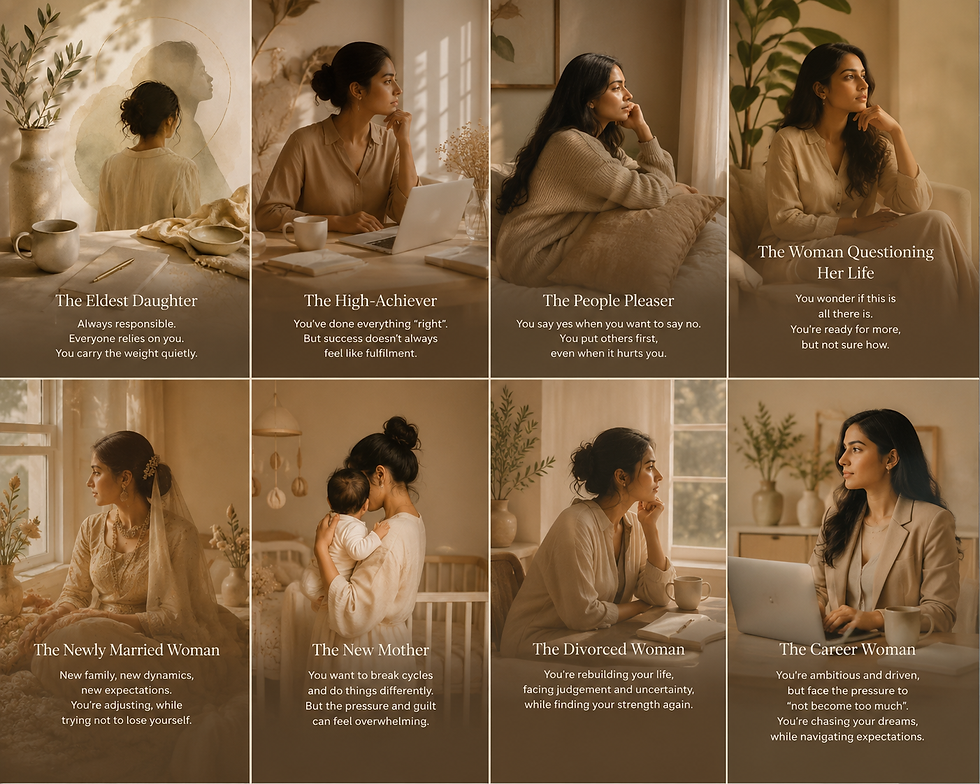
Because suddenly you are everything to everyone.
A mother.
A partner.
A daughter.
A daughter-in-law.
A professional.
A caregiver.
The person everyone turns to.
You pour yourself into raising your children.
You give them the love, safety and opportunities you wanted for them.
You teach them about culture.
You teach them about their roots.
You hope they feel proud of who they are.
But somewhere along the way, you may quietly wonder:
“Where did I go?”
The Woman Looking Back: The Empty Nest and The Questions That Arrive
Then one day, you blink.
And the children who once needed you for everything are becoming independent.
The house feels quieter.
The routines change.
The identity you built around caring for others begins to shift.
And questions you have pushed aside for years begin to surface.
“Who am I now?”
“What do I want?”
“What parts of myself did I put away?”
“Have I lived my life, or have I only fulfilled my responsibilities?”
These questions are not selfish.
They are human.
Because every woman deserves to know herself beyond the roles she has carried.
The Woman Who Chose Herself: The Journey of the ‘Black Sheep’
And then there are the women who chose differently.
The women who questioned traditions.
The women who created boundaries.
The women who followed a path their family didn’t understand.
The women who said:
“This doesn’t feel right for me.”
“I want something different.”
“I want to choose myself.”
Sometimes, these women become labelled as the “black sheep”.
But what does being the black sheep really mean?
Perhaps it means you were brave enough to break a pattern.
Perhaps it means you were the person who asked the questions previous generations were afraid to ask.
Perhaps it means you created an identity beyond expectations.
Because finding your voice does not mean rejecting your culture.
Choosing yourself does not mean abandoning your family.
Creating your own path does not mean you love your roots any less.
It means you are allowing yourself to grow.
The Power of Representation: Being Seen, Heard and Understood
Representation matters.
Because when you see someone who understands your experiences, something shifts.
You no longer have to explain every layer.
The cultural expectations.
The family dynamics.
The pressure to be successful.
The guilt of disappointing others.
The conflict between independence and tradition.
The feeling of being grateful, but still feeling lost.
To be seen is to feel recognised.
To be heard is to feel your experiences matter.
To be understood is to no longer feel alone.
This is why community matters.
Because true community is not just about belonging to a group.
It is about belonging as yourself.
Finding Yourself Without Losing Where You Come From
Your culture can be part of you without defining all of you.
Your family can matter deeply while you still create your own identity.
Your traditions can be honoured while you still choose your own path.
You do not have to choose between being South Asian and being yourself.
You can be both.
You can carry your ancestors' strength while creating your own story.
You can honour where you came from while discovering where you want to go.
At Niche Therapy, I support South Asian women who are navigating identity, cultural expectations, life transitions, relationships, burnout and the journey of reconnecting with themselves.
For the woman who feels stuck between who she has always been and who she is becoming.
For the woman who feels unseen beneath all the roles she carries.
For the woman quietly asking:
“Who am I when I am no longer trying to be everything everyone needs me to be?”
Therapy can be a space where you finally explore that question.
A space where your story is heard.
Where your experiences are understood.
Where you can reconnect with yourself — not as a daughter, wife, mother, professional or caregiver…
…but simply as you.


Comments